

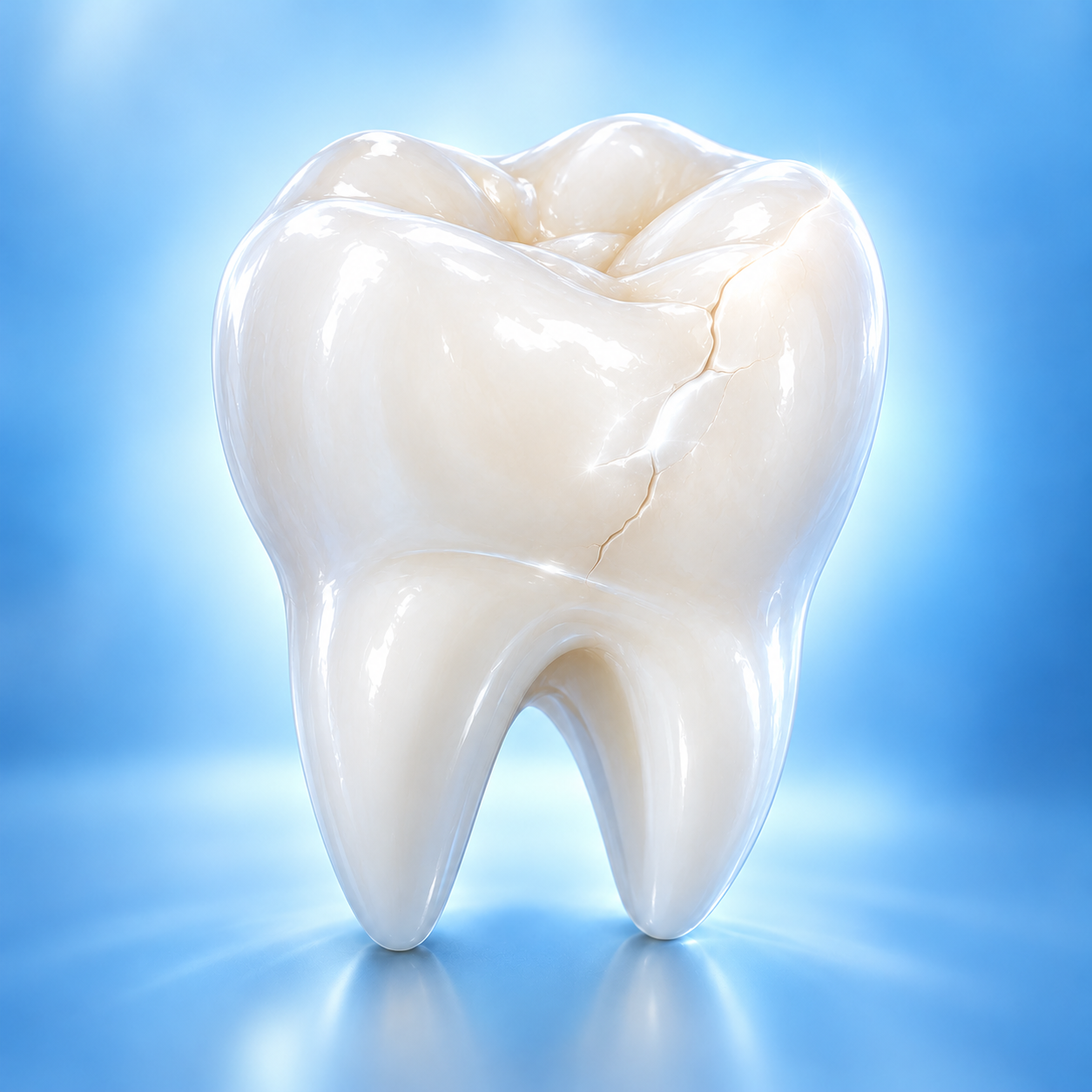
A new approach to restoring cracked teeth that preserves natural tooth structure and rethinks the shape of dental restorations.
Imagine discovering a crack in one of your teeth. For years, the traditional recommendation for many cracked teeth has been a crown. The thinking was straightforward: surround the damaged tooth with a strong protective covering to help prevent it from breaking further.
While crowns remain an important treatment option, modern dentistry is starting to ask a different question: What if we could strengthen and protect a tooth without removing so much of what makes it strong in the first place?
That question is at the heart of the BioClear Method, an innovative approach to restoring teeth that is changing how dentists think about cracks, cavities, and tooth preservation. Even more fascinating? One of the biggest innovations isn’t just the material we use. It’s the restoration’s shape.
Your teeth are incredibly strong, but they are not indestructible. Every day, they experience tremendous forces from chewing, clenching, and grinding. Over time, repeated stresses can cause tiny fractures to develop in the tooth structure. Some cracks occur naturally as teeth age. Others develop around large fillings or weakened areas.
One particularly important factor is the shape of traditional dental fillings. For generations, dentists were taught to prepare relatively box-shaped cavities in teeth. They developed these designs when restorative materials needed specific shapes to stay mechanically locked in place. Unfortunately, removing tooth structure to create these shapes can weaken the tooth’s remaining walls.
Think about a piece of wood with a sharp notch cut into it. When you apply force, stress can concentrate around that notch, making the wood more likely to fracture. Teeth can experience similar problems. The very shape of a traditional cavity preparation contributes to the stresses that lead to cracks.
Traditional dental restorations often start by creating space inside a tooth, then filling it with restorative material. BioClear challenges that approach. Instead of relying on conventional box-shaped preparations, the BioClear Method emphasizes more conservative, rounded, and carefully designed preparation shapes.
Why does that matter? Sharp internal corners can concentrate stress, while smooth transitions can distribute forces more evenly. In other words, the restoration’s geometry matters as much as the material used to create it.
With BioClear, we can often preserve more of the healthy tooth while designing a restoration that supports the remaining structure. This represents a fundamental shift in restorative dentistry. We are no longer simply filling holes. We are engineering restorations around the tooth’s natural structure.
One of BioClear’s most exciting applications is a technique called injection overmolding. Instead of simply placing a filling into a prepared cavity, we use specially designed transparent forms to rebuild and reshape parts of the tooth. These forms let warmed composite resin adapt closely to the existing tooth and form a carefully contoured restoration. The goal is to create a bonded restoration that helps support vulnerable tooth structure while preserving as much natural enamel and dentin as possible.
Think of the difference between repairing a cracked bowl by filling the crack and designing a repair that also supports the weakened area around it. The second approach considers the strength of the entire structure rather than focusing only on the defect. That is part of what makes BioClear so exciting.
When a tooth receives a conventional full crown, the dentist generally needs to reduce multiple surfaces to make room for the crown. In reality, this can remove up to 76% of the tooth surface.
Although crowns can provide excellent protection, the preparation process permanently removes natural tooth structure. BioClear offers a different possibility. Depending on the condition of the tooth, we may be able to:
The key difference is that BioClear may allow us to add strength and support while removing less healthy tooth structure.
However, BioClear is not appropriate for every cracked tooth. Some cracks require a crown, and others extend so deeply that the tooth can’t be saved with predictable success. The decision depends on the crack’s location and extent, the amount of remaining tooth structure, and the forces affecting the tooth.
In certain cases, a carefully designed, bonded composite restoration may help stabilize weakened tooth structure and reduce harmful flexing of vulnerable cusps. That is one reason BioClear’s overmolding and cusp-coverage techniques have attracted attention.
But there is an important distinction between supporting a weakened tooth and guaranteeing that a crack will never progress. No dental restoration can promise that. Cracks behave differently depending on their depth, direction, location, and the stresses placed on the tooth. A small crack within a tooth’s crown is very different from one that extends beneath the gumline or into the root.
Likewise, a restoration that works beautifully for one patient may not suit another. Our goal is not simply to choose the newest treatment. It is to choose the treatment that offers the best prognosis while preserving healthy tooth structure whenever possible.
Here’s something we believe every patient deserves to understand: Once we remove healthy tooth structure, we cannot grow it back.
A crown can restore a tooth beautifully, but it cannot replace the biological qualities of the original enamel and dentin. Natural tooth structure is an extraordinary material, designed to withstand years of chewing forces—the more structure we preserve, the more options we may retain for future treatment.
This becomes especially important when we consider a tooth’s lifetime. A restoration placed today will eventually need repair or replacement. When clinically appropriate, a conservative approach can leave more tooth structure available for whatever the future may bring.
That is the philosophy of minimally invasive dentistry. It is not about avoiding necessary treatment. It is about removing only what needs to be removed and preserving as much as we reasonably can.
BioClear has changed the conversation about restorative dentistry. We now have techniques that allow us to reconsider traditional cavity shapes, preserve more natural tooth structure, and use bonded composite in ways that were once much more difficult.
Does this mean crowns are becoming obsolete? Absolutely not. Crowns remain an essential tool, and in some situations they provide the most predictable protection for a damaged tooth. But BioClear gives us another option. And sometimes, having another option changes everything.
It’s about helping natural teeth remain strong, healthy, and functional for as long as possible. That means understanding the forces that caused the damage, respecting the tooth’s biology, and choosing the most conservative treatment that can predictably achieve our goals. Because the greatest success in restorative dentistry may not be how much of a tooth we can replace, it may be how much of the tooth we can save.