

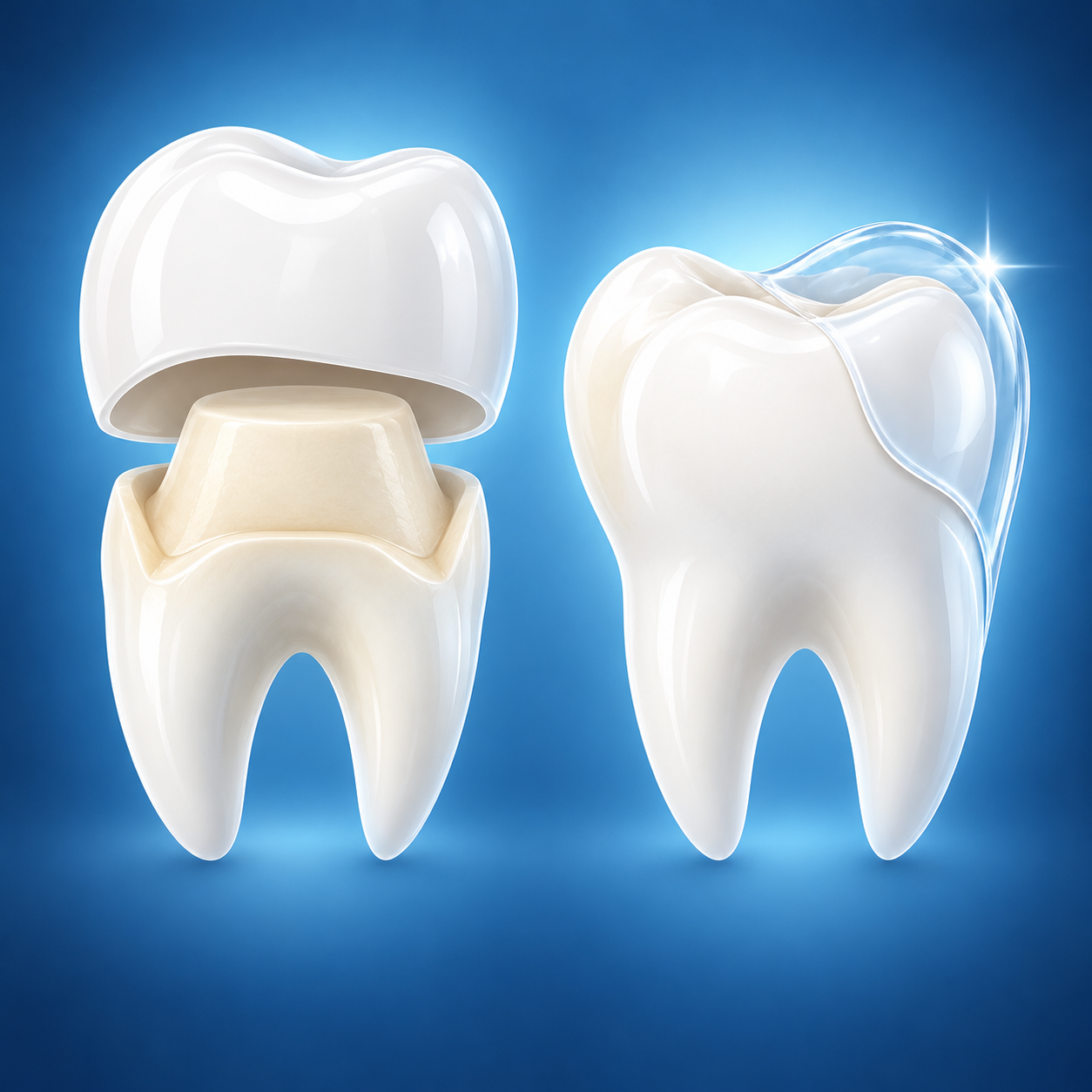
A revolutionary approach to dentistry is changing how we repair, protect, and preserve teeth.
For decades, dentistry has repaired damaged teeth by removing tooth structure and replacing it with crowns or other restorations. While these treatments have helped millions, they often require sacrificing healthy tooth structure along the way. But what if we could approach dentistry differently?
What if, instead of removing more tooth to make room for a restoration, we could preserve more of the natural tooth and rebuild what was lost? That is the philosophy behind BioClear, an innovative restorative technique that is changing the way dentists think about repairing teeth.
BioClear is a modern way to repair and rebuild teeth using a tooth-colored material called composite resin. Dentists have used composite for decades, but BioClear has changed how we use it. Developed by Dr. David Clark, the BioClear Method uses specially designed, clear forms and warmed composite resin to rebuild teeth. Think of it as creating a custom mold around your natural tooth, then filling it to restore chipped, worn, broken, or missing areas. The result is a strong, natural-looking restoration designed to blend with your tooth while restoring its original shape and function.
Traditional composite restorations are often built by adding and shaping small layers of material. BioClear takes a different approach. By using a technique called injection molding, dentists can create a more seamless restoration with smooth surfaces and natural contours.
But what makes BioClear truly exciting isn't just how beautiful the finished tooth can look. It's the ability to repair and rebuild teeth while preserving more of your healthy, natural tooth structure. And that represents an important shift in how we think about restoring teeth.
One of modern dentistry's most important principles is that your natural teeth are worth preserving. Once you remove enamel or dentin, your body cannot grow it back. Traditional crowns often require removing healthy tooth structure from several surfaces to make room for the crown. Sometimes a crown is the best option, especially when a tooth is severely damaged or weakened.
But not every damaged tooth needs a crown. BioClear gives us another option. Instead of removing more tooth structure, BioClear lets us add material to what is already there in many cases. We can rebuild worn, broken, or missing areas while preserving more of your natural tooth.
This is the idea behind minimally invasive dentistry: treating the problem while removing as little healthy tooth structure as possible. It represents an important change in how we approach dental care. Rather than immediately asking, "How do we prepare this tooth for a crown?" we can begin with a much more important question: "How much of your natural tooth can we save?" Because the more healthy tooth structure we can preserve today, the more options we may have to care for that tooth in the future.
You may be wondering, "Isn't BioClear just a fancy filling?" Not exactly.
Although traditional white fillings and BioClear restorations both use composite resin, the techniques differ. Dentists often place and shape traditional composite fillings in increments. Depending on the restoration's size and location, creating ideal contours, contacts, and smooth transitions can be challenging.
BioClear uses specialized forms that surround the tooth and help guide the restorative material into a more natural shape. The composite is warmed to improve handling and adaptation during injection molding. Careful cleaning, bonding, shaping, and polishing are also essential parts of the technique. The goal is a well-adapted, highly polished restoration with fewer irregularities and a natural appearance. It is not simply about using a different material. It is about using familiar materials in a more thoughtfully engineered way.
Teeth experience a remarkable amount of stress throughout our lives. We chew, clench, grind, and sometimes use our teeth in ways they were never designed to handle. Over time, teeth can develop cracks, chips, wear, and failing restorations. Historically, these problems often led directly to a recommendation for a crown. Today, BioClear may provide another option for certain teeth.
Using an approach sometimes called injection overmolding, dentists can rebuild missing portions of a tooth or add composite around selected surfaces without the extensive reduction associated with a conventional crown.
This does not mean BioClear can save every damaged tooth. The severity of cracks, remaining tooth structure, bite forces, and the tooth's overall health influence which treatment is appropriate. But having another conservative treatment option is a significant advancement.
BioClear is not limited to repairing cavities. It can also improve the appearance of teeth in surprisingly conservative ways.
For example, BioClear may help:
In many of these situations, BioClear allows dentists to add material rather than remove significant amounts of healthy enamel.
For patients who want to improve their smiles but hesitate to reshape their natural teeth for veneers or crowns permanently, this can be an appealing alternative.
One of BioClear's most fascinating aspects is that it treats restorative dentistry as both an art and an engineering challenge.
A successful restoration must do more than look good. It must also work with the tooth, withstand chewing forces, maintain healthy contours, and let patients clean around it effectively.
The BioClear Method places particular emphasis on five important steps:
Each step matters. And while BioClear offers exciting advantages, its long-term success still depends on careful diagnosis, proper technique, healthy supporting tissues, and managing the forces placed on the teeth.
No. And that is an important distinction. Crowns remain valuable and sometimes essential restorations. Some teeth are too severely damaged, structurally compromised, or heavily restored to support a direct composite restoration predictably.
BioClear is not a universal substitute for a crown, nor has it been proven to outlast crowns in every clinical situation. BioClear expands the choices available to patients. For certain teeth, we may be able to restore function and appearance while keeping more of the natural tooth intact. For other teeth, a crown, onlay, or different restoration may provide a more predictable long-term solution. The key is understanding each tooth's condition rather than assuming one treatment is right for everyone.
The most exciting advances in dentistry are not always about creating stronger artificial materials or more elaborate restorations. Sometimes the greatest advancement is learning how to do more with less.
BioClear is helping move restorative dentistry in that direction. Because the best dentistry is not necessarily the dentistry that replaces the most tooth structure, it is the dentistry that helps you keep as much of your natural tooth as possible, for as long as possible. And that is something worth smiling about.