

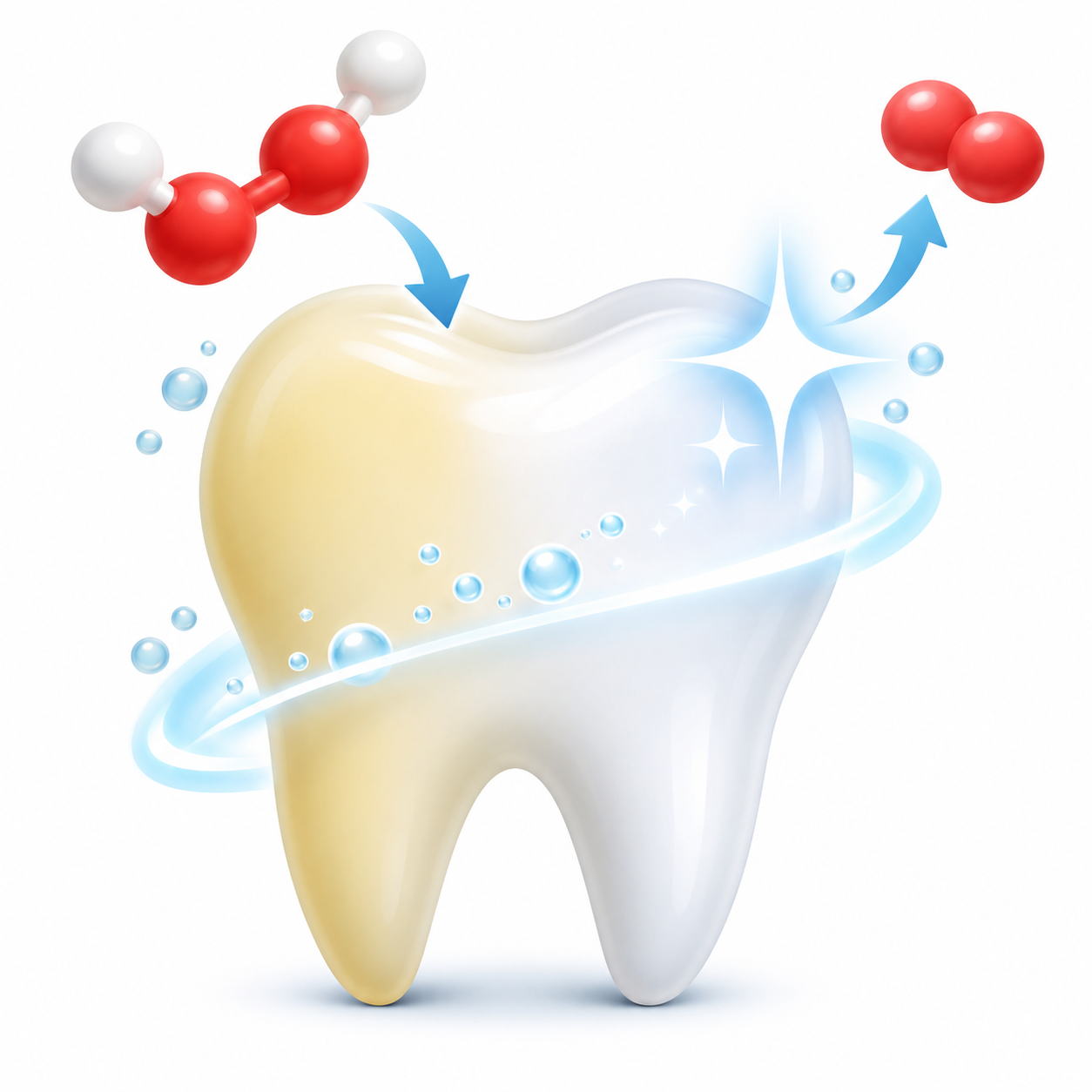
Have you ever wondered how a clear gel can turn yellowish teeth into a brighter, whiter smile? No white paint, no magical coating, and certainly no tiny cleaning crew scrubbing away inside your enamel. The secret is chemistry. And it’s actually pretty fascinating.
To understand how whitening works, we first need to understand why teeth have color in the first place. Enamel, the outer layer of your teeth, is somewhat translucent. Beneath it lies dentin, which naturally has a yellowish color. Over time, coffee, tea, red wine, and other colorful indulgences can contribute to discoloration. Some of these pigments work their way into the tooth structure, beyond the reach of even the most enthusiastic toothbrush.
This is where peroxide comes to the rescue. Most whitening products contain either hydrogen peroxide or carbamide peroxide. Carbamide peroxide breaks down to release hydrogen peroxide, so both ultimately work through the same active ingredient.
Hydrogen peroxide is a small molecule that can travel through enamel and into dentin. As it breaks down, it produces highly reactive molecules that interact with the compounds responsible for discoloration. These color-producing compounds contain structures called chromophores.
Now, before your eyes glaze over, stay with me. This is the interesting part.
Chromophores are the parts of molecules that absorb visible light, giving stains their color. Their chemical structure determines which wavelengths of light they absorb and, ultimately, how dark they appear.
Peroxide works through a chemical process called oxidation. It changes the structure of these color-producing molecules so they absorb light differently and become less noticeable. In other words, peroxide doesn’t simply scrub stains away. It changes their chemistry so they no longer appear as dark. Think of it like taking apart a colorful structure made of building blocks. The pieces may still be there, but once you rearrange them, they no longer produce the same color. Pretty impressive for something that looks like clear jelly.
So why doesn’t whitening happen instantly? Peroxide needs time to penetrate the tooth and react with enough color-producing molecules to make a visible difference. Peroxide concentration, how long it stays on the teeth, and the type of discoloration all influence the results.
And what about that occasional sensitivity? Because peroxide can travel through enamel and dentin, it can sometimes irritate the sensitive tissues inside the tooth. This is why some people experience temporary sensitivity during whitening. Fortunately, it usually resolves once whitening stops.
One final detail worth knowing: Whitening isn’t permanent. New pigments can accumulate over time, and teeth continue to change naturally as we age. Occasional touch-ups may be needed to maintain that brighter smile. And remember, peroxide whitens natural tooth structure, not crowns, veneers, or fillings. Chemistry is impressive, but even it has its limits.
There’s something wonderfully satisfying about knowing that a brighter smile isn’t magic, marketing, or a miracle. It’s simply a little oxidation putting on a very impressive show.