

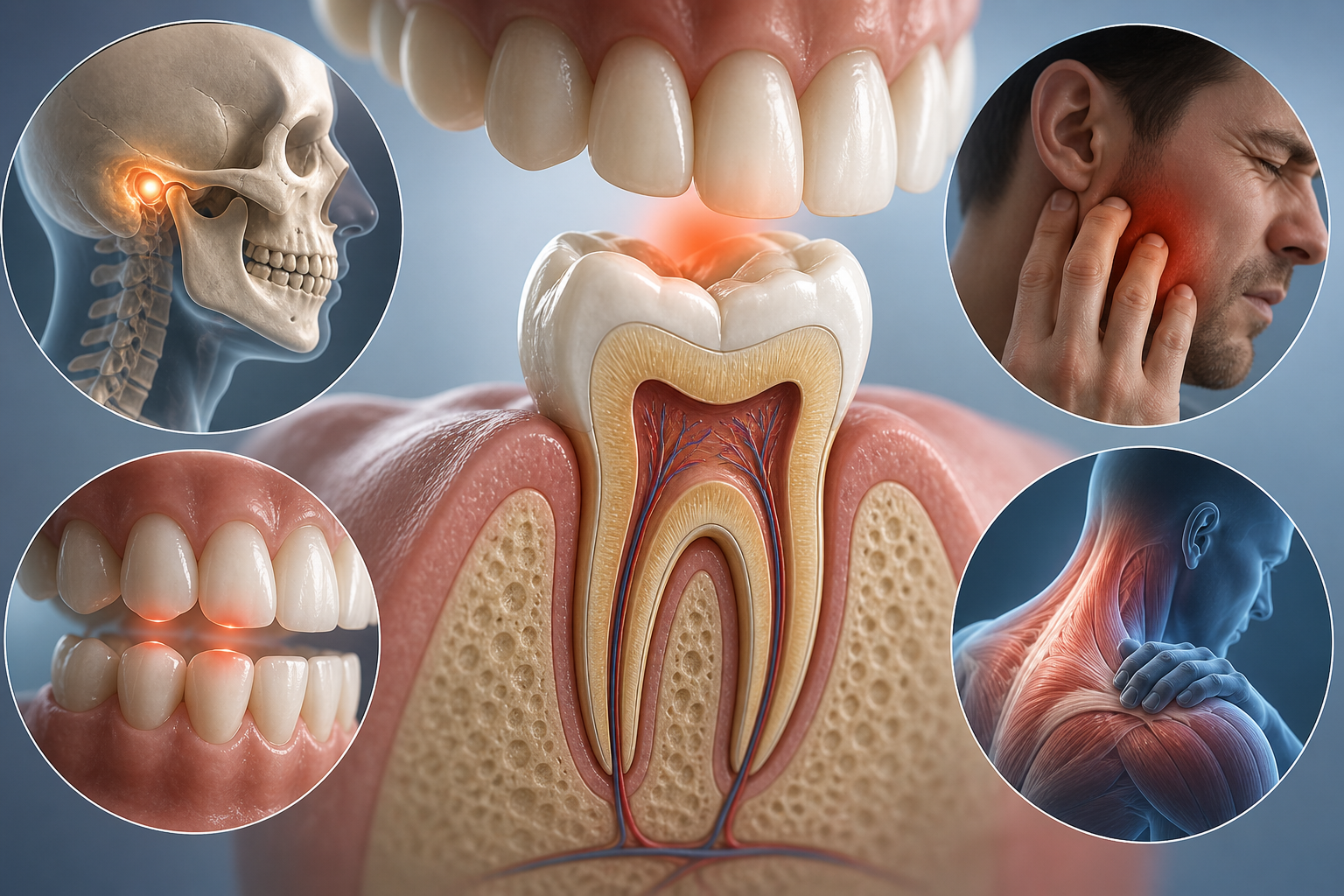
Most people associate root canals with cavities. While tooth decay is certainly a common cause, it is not the only one. In many cases, the underlying issue is not bacterial, it is mechanical. Specifically, it stems from an unbalanced chewing system.
The mouth is not simply a collection of individual teeth functioning independently. It is a coordinated system composed of teeth, muscles, and jaw joints, all designed to work together in harmony. Each time you chew, speak, or swallow, forces are distributed across this system.
When everything is in balance, those forces are shared evenly, allowing the teeth to withstand significant pressure without damage. However, when that balance is disrupted, certain teeth begin to carry more force than they were designed to handle.
In a healthy chewing system, the teeth come together with even contact. The chewing muscles can relax, and the jaw joints are supported in a stable, comfortable position. No single tooth is overloaded. Instead, the system functions efficiently, distributing forces in a way that protects each component.
An unbalanced chewing system occurs when this harmony is lost. Rather than even contact, certain teeth meet sooner or with greater intensity than others. These “high spots,” or first points of contact, may seem insignificant, but their impact is substantial.
Each time the teeth come together, these areas absorb a disproportionate amount of force. Over the course of a day, this repeated stress can occur thousands of times.
The body does not ignore this imbalance—it adapts to it. The muscles may become overactive as they attempt to guide the jaw into a more stable position, often leading to tension, fatigue, or clenching. The jaw joints may also shift or compensate, potentially resulting in strain or dysfunction over time.
A useful analogy is that of a table. When all four legs are even, the table is stable. If one leg bears more weight than the others, the structure becomes compromised. Initially, this instability may go unnoticed. Over time, however, the imbalance leads to failure.
In the oral environment, that failure often occurs within a single tooth.
When one tooth consistently absorbs the initial impact of biting, it is subjected to repeated microtrauma. Much like bending a paperclip back and forth, the damage accumulates gradually.
Although the tooth may appear intact externally, internal stress begins to build. Within the tooth lies the pulp—a soft tissue containing nerves and blood vessels.
As excessive force is applied over time, this tissue can become irritated and inflamed. Early signs may be subtle: mild sensitivity, a vague awareness that something feels “off,” or no symptoms at all.
However, if the stress persists, the pulp can become irreversibly damaged. Blood flow may be compromised, and the tissue begins to break down. At this stage, the tooth can no longer heal itself.
A root canal becomes necessary—not because of decay, but because the internal structures have been overwhelmed by chronic mechanical stress.
In this context, the root canal is not the cause of the problem; it is the solution to a process that has been developing over time.
Importantly, if the underlying imbalance is not addressed, the cycle can continue. The same forces that led to the breakdown of one tooth may begin to affect others.
This is why some individuals feel as though they are repeatedly treating symptoms without ever resolving the root cause. Teeth do not fail without reason—they respond to the environment in which they function.
By shifting our focus from isolated treatment to a comprehensive understanding of the chewing system, we move beyond repair and toward prevention.
When the teeth, muscles, and joints are allowed to function in harmony, we create a stable foundation—one that supports not only oral health, but overall well-being.
That is where lasting health begins.