

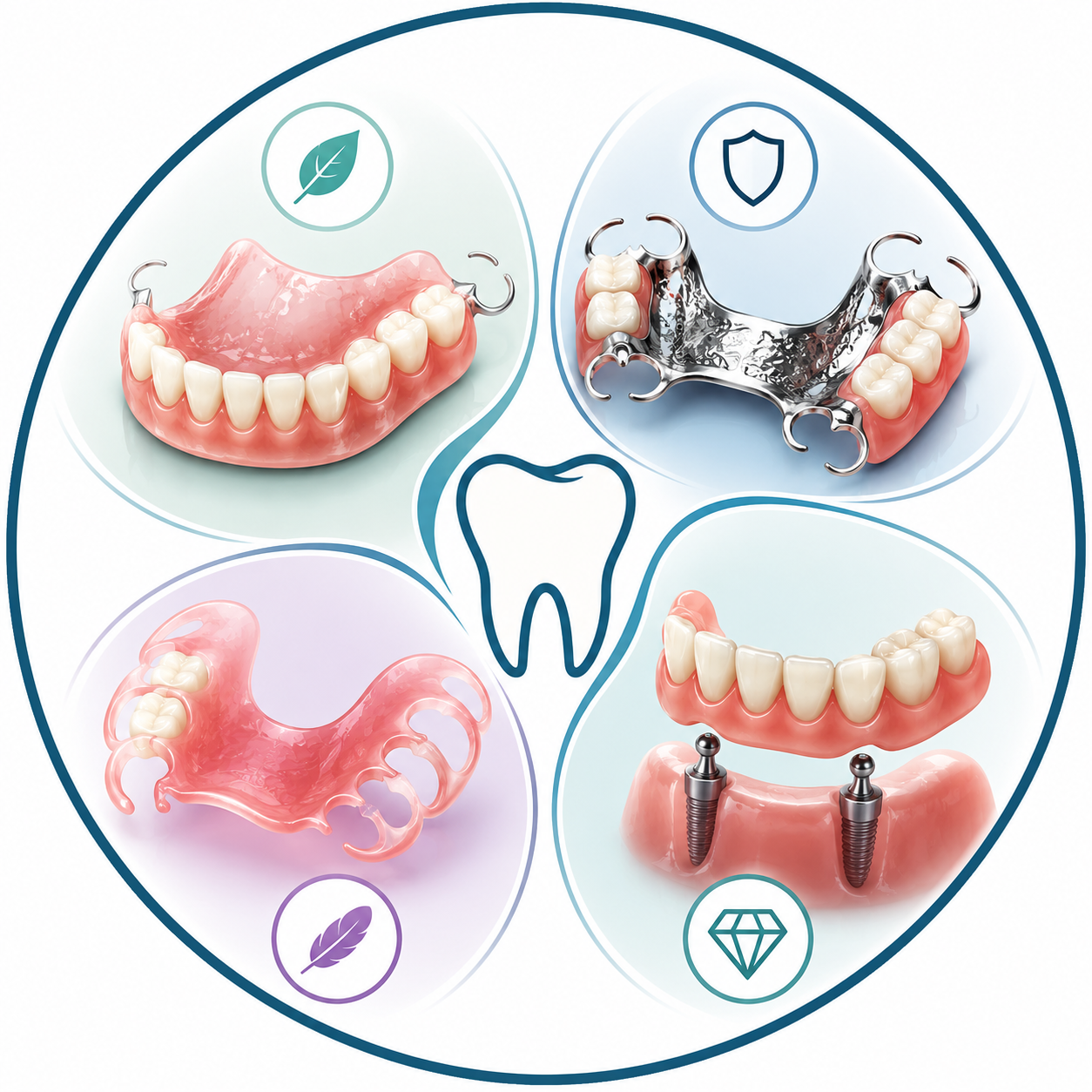
When most people hear the words "partial denture," they picture a removable appliance with metal hooks that replaces a few missing teeth. While that image isn't wrong, it's only one type of partial denture.
Today's removable partial dentures come in several different designs, each made from different materials and each offering its own advantages and limitations. Choosing the right one isn't simply about replacing missing teeth. It's about restoring your ability to chew comfortably, protecting your remaining teeth, and preserving your long-term oral health.
A partial denture is a removable appliance designed to replace one or more missing teeth while using your remaining natural teeth and gums for support. The goal is much more than filling a space. A properly designed partial helps restore chewing, improve speech, maintain appearance, and reduce excessive forces on the remaining teeth.
An acrylic partial denture is typically made from pink acrylic resin, the same material commonly used for full dentures. The replacement teeth are made from either acrylic or porcelain and are attached directly to the acrylic base. Small wire clasps may be added to help hold the appliance in place.
Because acrylic is relatively inexpensive and easy to adjust or repair, these appliances are often used as temporary replacements after an extraction or while waiting for a more permanent restoration.
Compared with other partial dentures, acrylic partials are:
A cast metal partial denture has a framework made from a cobalt-chromium alloy, an extremely strong and lightweight metal. Pink acrylic is added only where replacement teeth and gum tissue are needed, while the metal framework fits precisely around the remaining teeth.
Because the metal is so strong, the framework can be very thin. This makes the appliance feel less bulky while distributing chewing forces more evenly between the teeth and gums.
Compared with other designs, cast metal partials are:
Although some metal clasps may be visible when smiling, they provide excellent retention and stability.
Flexible partial dentures are made from a thermoplastic nylon material instead of acrylic or metal. Because the material bends slightly, the appliance can flex when inserted and removed.
One of the biggest advantages is aesthetics. Instead of metal clasps, the flexible material forms gum-colored clasps that blend naturally with the surrounding tissues.
However, flexibility comes with trade-offs. Because the appliance bends during function, it may not distribute chewing forces as predictably as a rigid cast metal framework. It can also be more difficult to adjust or repair if changes are needed later.
Compared with other partial dentures, flexible partials are:
For the right patient, they can be an excellent option. For others, their flexibility may actually become a disadvantage.
An implant-supported partial denture combines a removable prosthesis with one or more titanium dental implants placed in the jawbone. The implants act like artificial tooth roots, providing additional support and stability.
The removable portion of the appliance may be made from acrylic, metal, or a combination of materials depending on the design. Special attachments connect the denture securely to the implants.
Compared with conventional partial dentures, implant-supported designs:
For many patients, implants provide the closest experience to having natural teeth again.
There isn't one "best" partial denture. The ideal choice depends on many factors, including the number and location of missing teeth, the health of your remaining teeth and gums, your bite, your chewing forces, your goals, and your budget.
Every material has strengths. Every material has limitations. My job is to help you understand those differences so together we can choose the option that best supports your smile for years to come.
At Voyage to Vitality, we believe replacing missing teeth isn't simply about filling empty spaces. It's about restoring balance to your entire chewing system and helping your remaining teeth stay healthy for as long as possible.